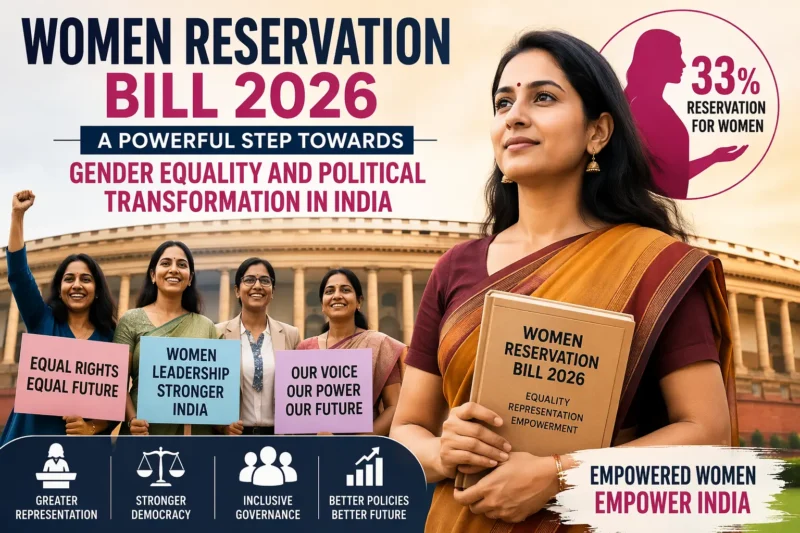
Introduction: Women Reservation Bill
India is the largest democracy in the world, but women have not had enough representation in its politics for decades. Even though they make up almost half of the population, they have historically had limited representation in legislative bodies. The Women’s Reservation Bill has been talked about for years and is now back in the news in 2026. Its goal is to change that.
The plan to set aside 33% of seats in Parliament and state legislatures for women is not just a political reform; it is a deeper step toward equality, inclusion, and empowerment. What does this bill really mean for women’s rights and politics in India? Let’s look into it.
What is the Women Reservation Bill?
The Women Reservation Bill proposes to reserve one-third of the total seats in the Lok Sabha as well as in legislative assemblies in different states for women. These will be inclusive of the seats allocated to Scheduled Castes (SC) and Scheduled Tribes (ST).
- This Bill has been proposed to achieve the following:
- Enhance women’s involvement in decision making
- Gender balance in representation
- Democratic and participative governance
Many countries have taken such steps to ensure women’s active involvement in politics, and so has India.
Why Should Women Reservation Be Taken Seriously?
- Balancing the Gender Equation in Politics
India has lagged behind many countries regarding women’s representation in the Lok Sabha. As of 2026, women MPs account for less than half.
This disparity has implications for policy-making. With few female representatives, concerns such as maternity care, gender-based violence, girl’s education, and work-life balance may be overlooked.
- Democratization Process
An ideal democracy needs to represent all sections of its society. Women have unique viewpoints, ideas, and policies to offer that would benefit governance processes.
The bill ensures that:
- Governance is inclusive
- Policies cover broader areas
- Society is adequately represented
- Women Empowerment
Women’s political presence influences their empowerment in society. Women tend to be inspired when they see fellow females in governance positions.
Reservation will help:
- Remove social restrictions
- Encourage women leaders
- Enhance gender equality
Read More:- “Bhooth Bangla First Weekend Box Office Prediction: Will It Go Over ₹50 Cr?”
Key Characteristics of the Bill
Here are the important aspects of the Women Reservation Bill:
- Reservation for women at 33%
- Applicable for SC/ST reserved seats also
- Rotation of seats from one constituency to another
- Implementation is expected post-delimitation
The rotation system helps ensure that all areas get their due share, although it does come with its own set of problems
Effect on Indian Politics
- Alteration in Political Landscape
The introduction of a substantial number of women in politics would drastically change the approach of the parties involved. It would be necessary for the parties to:
- Recruit women leaders
- Train women in politics
- Move towards inclusive campaigns
- Emergence of Fresh Leaders
The reservation system would give rise to new women leaders who might not belong to the usual political hierarchy.
It would:
- Minimize the dominance of dynasty politics
- Make way for grass-root leaders
- Enhance diversity in leadership
- Shift in Policy Framework
According to research conducted in rural governance systems such as Panchayats, it was found that women leaders focused more on:
- Health and hygiene
- Educational institutions
- Social welfare programs
- Community development
Such changes may also arise at the national level because of the presence of more women in Parliament.
Impact on Women Rights
- Improved Legal Structures
Due to higher representation of women in political offices, legislation concerning:
- Domestic abuse
- Sexual harassment in the workplace
- Child marriages
- Pay equity
will probably be prioritized.
- Societal Shifts
Representation means normalization. The mere presence of women in leadership positions changes society’s mindset.
It could:
- Dispel myths
- Encourage gender parity
- Create acceptance for women leaders
- Economic Opportunities
Leadership may mean economic power. Laws regarding:
- Women’s entrepreneurship
- Training
- Job creation
could gain support.
Problems and Objections
Although the bill has several merits, it is not devoid of criticism.
- Rotation of Seats
The rotation policy implies that seats reserved for women will vary from one election to another. This can have the following implications:
Disruption of continuity
Obstruction of long-term planning
Uncertainty on the part of the candidate
- Symbolic Representation
According to some scholars, there is a possibility of proxy representation in which women will be elected to office, while their male counterparts will wield power through them.
But eventually, this practice will diminish since the female candidates will become experienced and confident.
- Absence of Sub-Quota
Currently, there is much discussion regarding the introduction of a sub-quota for OBC women in the reservation process.
Its absence might affect some social groups negatively.
Lessons from Local Governance
There is ample precedent in India itself, since women’s reservations have existed in Panchayats, with 33% (50% in some states) reserved for women.
These have yielded positive results:
- Higher women’s participation
- Greater emphasis on communal well-being
- Development of competent women leaders
These positive results provide optimism about replicating such success at other governance levels.
Global Context
Other nations too have adopted the principle of gender reservation in politics, for example:
- Rwanda (women constitute over 60% of members in Parliament)
- Sweden and Norway (where women are highly represented)
- France (laws ensuring gender parity)
These examples demonstrate how effective reservations could be in ensuring substantial improve representation and governance quality.
The Road Ahead
The Women Reservation Bill 2026 may become one of the most important events in the history of India.
Nevertheless, the success of the bill requires:
- Political will
- Educating and empowering women politicians
- Public awareness
- Sound institutional frameworks
Reservation should be backed up by other social and economic measures.
Conclusion: Women Reservation Bill
The Women Reservation Bill 2026 is not simply a change in legislation; it represents an important step forward for Indian society. By guaranteeing women’s representation in Parliament and state assemblies at the level of 33%, the nation is advancing toward real democracy.
Even though there are still numerous obstacles on the way, the positive effect of this decision exceeds any fears.
From altering the political landscape to promoting the empowerment of women, this act has everything to positively affect the future of the nation.
Read More:- MP Board Result 2026: Where to Find Your 10th and 12th Results at mpbse.nic.in
