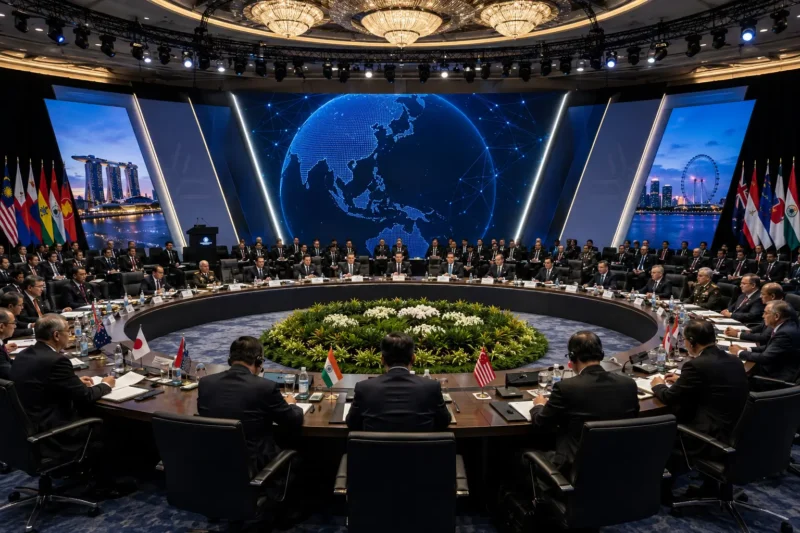
What is Shangri-La Dialogue 2026 and why does it matter? In just 48 hours, this Singapore summit has already sent shockwaves across the Asia-Pacific — redefining how America, China, and Taiwan will coexist in one of the world’s most volatile regions.
On May 30, 2026, US Defense Secretary Pete Hegseth took the podium at Singapore’s Shangri-La Hotel for the 23rd edition of Asia’s most powerful security summit. His speech — delivered just two weeks after President Trump’s historic visit to Beijing — was one of the most closely watched addresses in the forum’s history. The world wanted to know: has America gone soft on China? Is Taiwan being quietly abandoned? And why, for the second year running, did China’s own Defense Minister refuse to show up?
This article breaks down every critical development from Singapore — in plain language, backed by today’s live reporting — so you understand exactly what happened and why it matters to the world.
23rd Edition of Shangri-La Dialogue
2nd Year China’s minister skipped
$14B Taiwan arms deal Trump paused
10+ Indo-Pacific nations in attendance
1. What Is Shangri-La Dialogue 2026 and Why Does It Matter?
Understanding what is Shangri-La Dialogue 2026 and why it matters starts with knowing what kind of event this actually is. The Shangri-La Dialogue — named after the luxury Singapore hotel where it takes place — is Asia’s most important annual defense and security forum, organized by the International Institute for Strategic Studies (IISS). Every year, defense ministers, military chiefs, senior diplomats, and security analysts gather for three days of high-stakes speeches, bilateral meetings, and behind-the-scenes negotiations.
Unlike formal diplomatic summits, Shangri-La is a place where countries signal their true intentions without being bound by official communiqués. A softer speech here means a genuine policy shift. A hardening of language means a warning. An absence — like China’s this year — speaks louder than any speech.
Why 2026 Is Different From Every Previous Year
The 2026 edition is uniquely consequential for four reasons:
- It follows Trump’s historic bilateral summit with China’s Xi Jinping in Beijing on May 14–15, 2026 — the first direct meeting of this kind under Trump’s second term
- It takes place as the US-Iran ceasefire remains fragile, with 57% of China’s crude oil imports flowing through the Middle East via sea
- Trump has publicly described Taiwan arms sales as a possible “bargaining chip” with Beijing — alarming every US ally in the region
- China’s defense minister skipped Shangri-La for the second consecutive year — a diplomatic signal with profound strategic meaning
2. Pete Hegseth China Speech — Shangri-La Dialogue May 30, 2026
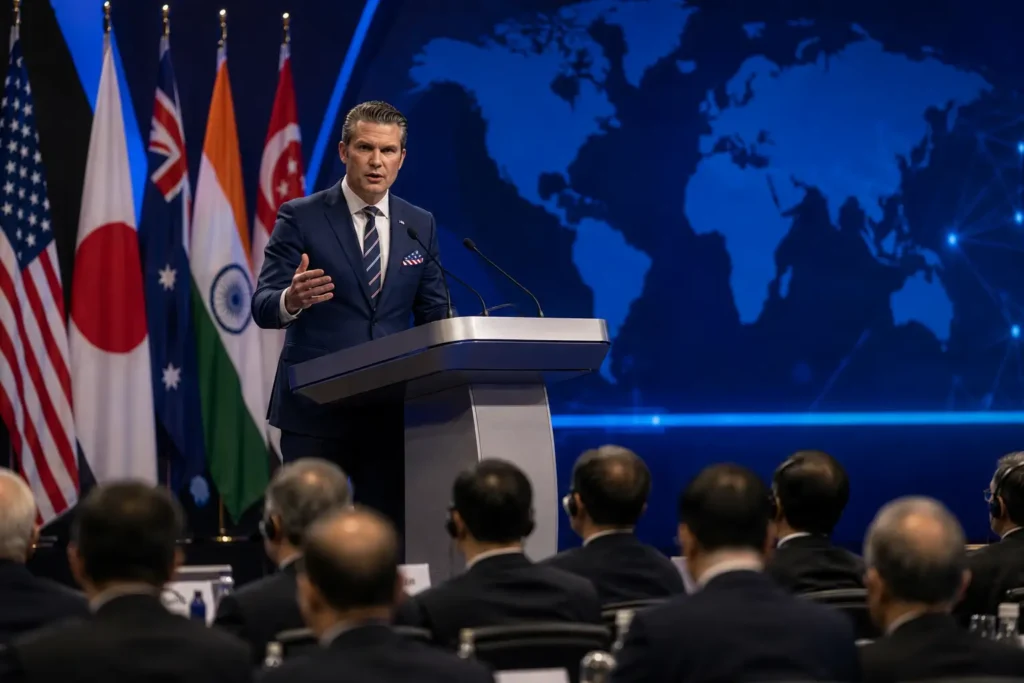
The world was watching closely for the Pete Hegseth China speech at Shangri-La Dialogue on May 30, 2026 — and what they heard was fundamentally different from last year’s fire-and-brimstone warnings about Chinese aggression.
The Tone Shift That Changed Everything
In 2025, Hegseth arrived at Shangri-La with a direct warning: “Any attempt by Communist China to conquer Taiwan by force would result in devastating consequences for the Indo-Pacific and the world.” He called China’s threat “real” and “potentially imminent.”
In 2026, the same man stood at the same podium and described US-China relations as “better than they’ve been in many years.” He spoke of seeking “stable peace,” “fair trade,” and “respectful relations.” The word he returned to most — deliberately — was “quiet.”
“We do not approach this challenge with needless confrontation but with a posture of measured and deliberate strength.” — Pete Hegseth, US Defense Secretary, Shangri-La Dialogue, May 30, 2026
Read More:- FIFA World Cup 2026 Complete Schedule Dates India: The Ultimate Unmissable Fan Guide with All Groups & Teams
What Hegseth Said — And What He Didn’t
| Topic | Hegseth 2025 (Strong) | Hegseth 2026 (Softer) |
|---|---|---|
| China threat | Real & imminent | Historic military build-up (noted) |
| Taiwan | Explicitly defended | Omitted in ally roll call |
| China relations | Confrontational | Best in years |
| US strategy word | Deterrence | Quiet strength |
| Taiwan arms pause | N/A | Denied link to Iran war |
Critically, when Hegseth listed the Indo-Pacific partners who are stepping up their defense spending — Australia, India, Indonesia, Japan, Malaysia, Philippines, South Korea, Singapore, Thailand, and Vietnam — Taiwan was not mentioned by name. For Taiwan’s supporters, that omission was deafening.
What Analysts Are Saying Senior US Senator Tammy Duckworth told reporters after the speech: “The latest national defense strategy drafted by Trump and Hegseth downgraded the importance of the Indo-Pacific — which is contrary to what happened in the first Trump term.” The message from within Washington’s own political establishment is clear: something has shifted.
3. US China Taiwan relations after Singapore summit 2026
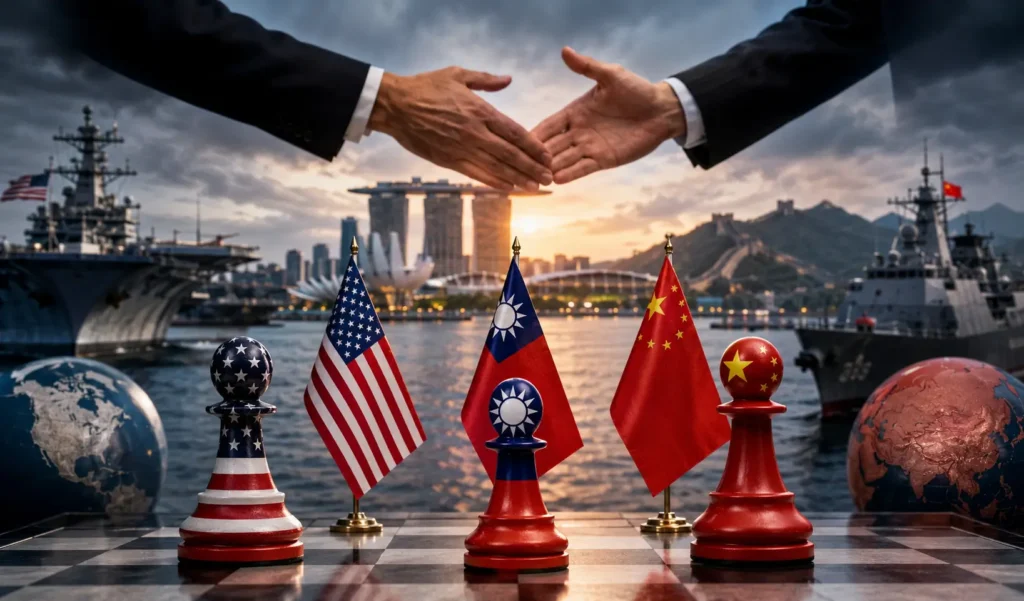
To understand US–China–Taiwan relations after the Singapore summit 2026, we must connect three developments that together paint a worrying picture for Taiwan’s security.
The Trump Xi Beijing Summit (May 14–15, 2026)
Just two weeks before Shangri-La, Trump flew to Beijing for direct talks with President Xi Jinping — a summit described as “truly historic” by Hegseth himself. The two leaders reportedly agreed to build a “constructive relationship of strategic stability based on fairness and reciprocity.” In plain terms: America and China are actively trying to reduce conflict and cooperate economically.
Taiwan Weapons Pause: The $14 Billion Signal
Trump has publicly called Taiwan arms sales a potential “bargaining chip” in US-China negotiations — and then paused a $14 billion weapons package for Taiwan. Acting US Navy Secretary Hung Cao initially cited weapons shortages from the Iran war as the reason. Hegseth at Shangri-La denied that explanation, saying the pause was unrelated to the Middle East.
Either explanation raises a disturbing question: is the world’s most powerful military reducing its commitment to defending a democratic island of 23 million people as a favor to Beijing?
- Trump administration’s 2026 National Defense Strategy uses noticeably softer language on China than any previous version
- US-China military-to-military communications have been deliberately increased to “reduce miscalculation”
- The $11 billion HIMARS and howitzer arms sale approved earlier remains intact — but the $14 billion package is frozen
The Taiwan Risk Beijing has repeatedly threatened to take Taiwan by force if necessary, and has ramped up military drills around the island. Against this backdrop, every softening of US language — every omission of Taiwan from a roll call — is analyzed in Beijing, Taipei, and Washington as a potential green light or a red line being quietly moved.
4. Why Did China’s Defense Minister Skip Shangri-La Dialogue 2026?
Understanding why China’s defense minister skipped Shangri-La Dialogue 2026 requires looking beyond the official explanation and reading Beijing’s strategic calculations.
The Official Non-Answer
China sent what it described as “experts and scholars” from the People’s Liberation Army — not Defense Minister Dong Jun. Beijing regards Shangri-La as a US-dominated forum, and has skipped it for two consecutive years. In 2024, then-Defense Minister Lloyd Austin met his Chinese counterpart there. That era of engagement appears to be over.
What the Absence Actually Communicates
Analysts offer several readings of China’s no-show, and all of them matter:
- Power signaling: Analysts at the Singapore Institute of International Affairs described the absence as a reflection of “China’s rising power” — Beijing no longer feels it needs to attend forums it didn’t design
- Taiwan leverage: By staying away, China avoids any formal bilateral meeting with Hegseth while simultaneously warning the US over Taiwan arms sales
- Strategic ambiguity: Sending “scholars” instead of officials allows China to monitor the summit’s signals without committing to any formal positions
Historical Note In 2024, China’s defense minister attended Shangri-La and held direct meetings with the US defense secretary on the sidelines. The shift from full engagement in 2024 to total absence in 2025 and 2026 marks one of the most significant diplomatic withdrawals in the forum’s 23-year history.
FAQs
What is the Shangri-La Dialogue and who attends it?
The Shangri-La Dialogue is Asia’s premier annual defense and security forum, organized by the International Institute for Strategic Studies (IISS) and held in Singapore. It brings together defense ministers, military chiefs, diplomats, and security analysts from across the Asia-Pacific and beyond for three days of speeches and bilateral meetings.
What did Pete Hegseth say about China at Shangri-La Dialogue on May 30, 2026?
Hegseth described US-China relations as “better than they’ve been in many years” and called for “stable peace, fair trade, and respectful relations.” He notably softened his tone compared to 2025, acknowledged China’s military build-up without calling it imminent, and did not mention Taiwan by name when listing Indo-Pacific allies stepping up on defense.
The Verdict: A Watershed Moment for Asia-Pacific Security
Shangri-La Dialogue 2026 has delivered a message the world did not fully expect: the United States is quietly recalibrating its approach to China — and Taiwan is caught in the middle. Pete Hegseth’s softer speech, the paused arms deal, the omission of Taiwan from key lists, and China’s deliberate absence from the forum all point in the same direction.
This does not mean war is coming, or that peace is guaranteed. It means the rules of Asia-Pacific security are being rewritten in real time — in boardrooms, bilateral summits, and the measured silences of a Singapore hotel ballroom. The next six months will reveal whether America’s “quiet strength” is a strategy or a retreat.
Read More:- FIFA World Cup 2026 Complete Schedule Dates India: The Ultimate Unmissable Fan Guide with All Groups & Teams
