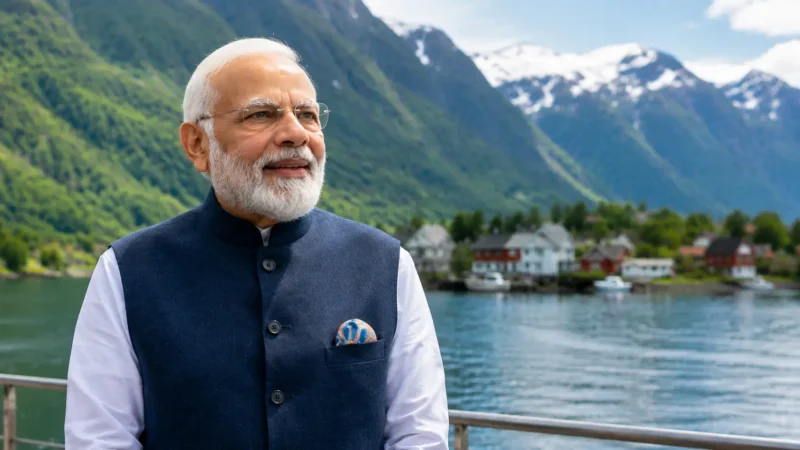
Modi 5-Nation Tour 2026
Prime Minister Narendra Modi 5-Nation Tour 2026 — spanning the UAE, Netherlands, Sweden, Norway, and Italy from May 15 to 20 — is one of the most consequential diplomatic missions India has undertaken in recent years. Coming at a time when the Strait of Hormuz tensions are rattling global energy markets, and with the India-EU Free Trade Agreement freshly concluded in January 2026, this six-day sprint across the Gulf and Europe is about far more than handshakes and photo opportunities. It is about locking India into the next generation of global technology supply chains, green energy networks, and strategic alliances.
Stop 1 — UAE: Energy Security at the Strait of Hormuz
The tour opened in Abu Dhabi on May 15, where PM Modi met UAE President Sheikh Mohamed bin Zayed Al Nahyan. The timing was deliberate and strategic. With ongoing West Asia tensions threatening the closure of the Strait of Hormuz — a chokepoint through which a significant share of India’s crude oil imports pass — energy security was front and centre of the agenda.
The two leaders reviewed the bilateral Comprehensive Strategic Partnership, discussing energy cooperation, investment, trade, and regional stability. The UAE has emerged as one of India’s most reliable Gulf partners, and this meeting reinforced that the bilateral relationship is built to withstand geopolitical turbulence.
For India, which is heavily dependent on Gulf oil, ensuring uninterrupted energy flows is a non-negotiable priority. The Modi-MBZ meeting sent a strong signal to global markets that India is actively managing its energy exposure.
Stop 2 — Netherlands: Semiconductors, ASML & Green Hydrogen
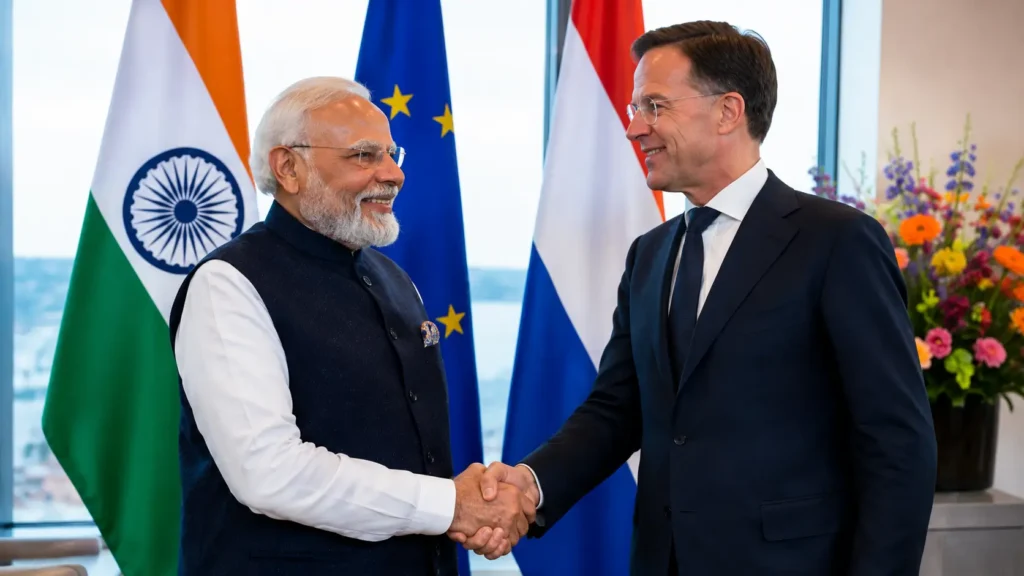
From Abu Dhabi, Modi flew to The Hague for a May 15–17 visit that carried enormous strategic weight for India’s technology ambitions.
The Netherlands is home to ASML — the only company in the world that manufactures the extreme ultraviolet (EUV) lithography machines essential for producing cutting-edge semiconductors. India has long sought access to this technology as part of its push to build a domestic chip manufacturing ecosystem under the ‘Make in India’ initiative. This visit presented the clearest opportunity yet to advance that goal.
Key areas on the bilateral agenda included:
- Semiconductors — Deepening cooperation in chip technology and advanced manufacturing
- Green hydrogen — Aligning India’s National Green Hydrogen Mission with Dutch clean energy expertise
- Water management — Tapping Dutch world-class expertise to address India’s growing water crisis
- Defence and security — Expanding cooperation in emerging threat landscapes
- Innovation — Building resilient supply chains post India-EU FTA
The Netherlands is already one of India’s largest trade partners in Europe, with bilateral trade reaching USD 27.8 billion in 2024–25, and cumulative Dutch FDI in India standing at USD 55.6 billion. A Strategic Partnership agreement was signed during the visit, putting the relationship on a more durable long-term footing.
Read More:- VD Satheesan Defies All Odds to Become Kerala Chief Minister After 10-Day Crisis
Stop 3 — Sweden: AI, Startups & the India-EU FTA Dividend
Modi arrived in Gothenburg on May 17–18, making this his second visit to Sweden — the first having been in 2018 for the inaugural India-Nordic Summit.
Sweden’s importance to India has grown significantly following the India-EU Free Trade Agreement announced in January 2026, which is expected to come into force in early 2027. As an EU member with deep expertise in clean technology, defence manufacturing, and digital innovation, Sweden is a natural partner for India as it prepares to leverage the FTA.
The Modi-Kristersson agenda focused on:
- Artificial intelligence — Building frameworks for responsible AI collaboration
- Green transition — Joint efforts on sustainable manufacturing and climate tech
- Startups and emerging technologies — Connecting India’s thriving startup ecosystem with Swedish innovation
- Defence — Exploring co-production opportunities
- Resilient supply chains — Reducing dependency on fragile global supply links
Notably, both Prime Ministers jointly addressed the European Round Table for Industry alongside European Commission President Ursula von der Leyen — a powerful signal of India’s growing integration into European industrial frameworks. India-Sweden bilateral trade reached USD 7.75 billion in 2025, with ample room to grow.
Stop 4 — Norway: A Historic Visit After 43 Years & the 3rd India-Nordic Summit
This was arguably the most symbolically significant stop on the tour. PM Modi’s visit to Oslo on May 18–19 marked the first visit by Modi Norway historic visit in 43 years — and Modi’s first-ever visit to the country.
Norway’s Ambassador to India, May-Elin Stener, described it as “historic” in every sense. The visit included bilateral talks with Norwegian PM Jonas Gahr Støre, an audience with King Harald V and Queen Sonja, and a joint address at the India-Norway Business and Research Summit.
The centrepiece of the Norway stop was the 3rd India-Nordic Summit in Oslo on May 19, bringing together PM Modi with the leaders of all five Nordic nations — Norway, Denmark, Finland, Iceland, and Sweden. This summit built on the foundations laid at the earlier editions in Stockholm (2018) and Copenhagen (2022).
The summit agenda covered:
- Green hydrogen and renewable energy — Harnessing Nordic expertise for India’s clean energy transition
- Blue economy — Fisheries, maritime trade, and ocean resource management
- Arctic cooperation — A growing area of strategic relevance
- Sustainability — Circular economy and climate commitments
- Emerging technologies — Digital public goods and innovation ecosystems
- Defence and space — Expanding strategic convergence
India’s bilateral trade with the five Nordic countries collectively reached nearly USD 19 billion in 2024, and the visit is expected to inject fresh momentum into both bilateral and multilateral cooperation. Norway’s Government Pension Fund Global (GPFG) already has close to USD 28 billion invested in the Indian capital market — a figure that reflects deep institutional confidence in India’s growth story.
Stop 5 —Italy: India–Meloni Bilateral & the India-EU FTA Push
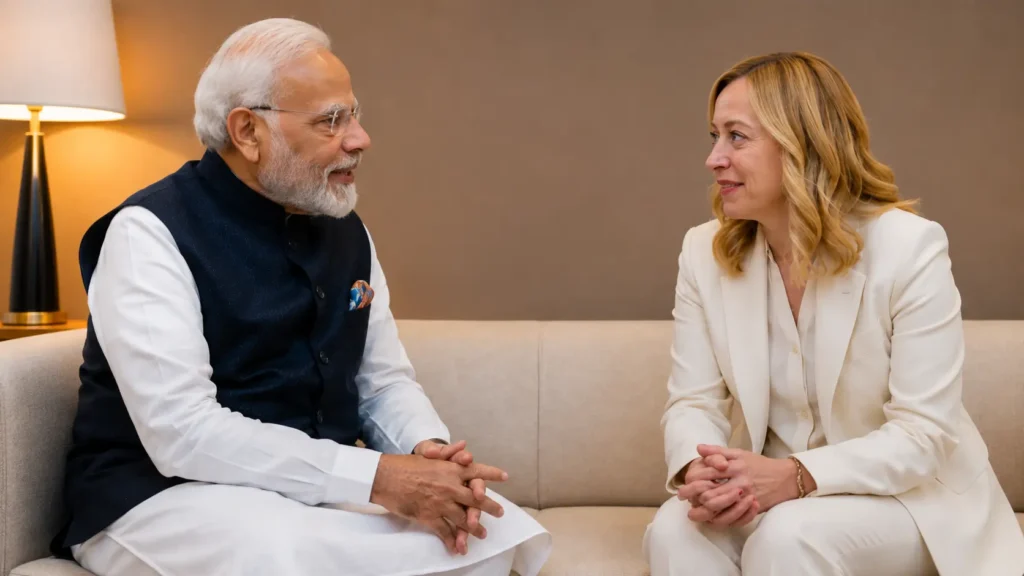
The final leg took Modi to Rome on May 19–20 for a standalone bilateral with Italian PM Giorgia Meloni — the culmination of an invitation that Italian Deputy PM Antonio Tajani had extended on Meloni’s behalf in December 2025.
The two leaders have built a strong personal rapport across multiple G7 and G20 interactions. The India-Italy Joint Strategic Action Plan 2025–2029 provides the structural roadmap, and this meeting was about accelerating implementation.
Key items on the Rome agenda included:
- Fast-tracking the India-EU Free Trade Agreement — Italy, as a major EU economy, can play an influential role in smooth ratification
- Defence co-production — Deepening manufacturing partnerships in aerospace and naval systems
- IMEC (India-Middle East-Europe Economic Corridor) — Advancing the game-changing connectivity corridor
- Science and technology — Space exploration, emerging tech and research collaboration
- People-to-people ties — Cultural, educational and diaspora engagement
India-Italy bilateral trade reached USD 16.77 billion in 2025, and both sides have clearly identified defence, clean energy, and digital technology as the pillars of the next phase of their relationship.
Why This Tour Matters: The Big Picture
PM Modi 5-nation tour 2026 is not happening in isolation. It sits at the intersection of several major global shifts:
The India-EU FTA Effect — The free trade agreement concluded in January 2026 changes India’s economic relationship with Europe fundamentally. Every European stop on this tour was, in part, a conversation about capturing that dividend.
Technology Supply Chain Diversification — From ASML’s chip machines in the Netherlands to AI partnerships in Sweden and Norway, India is methodically building access to critical technologies as global supply chains fragment.
Energy Security in an Unstable World — The Hormuz crisis gave the UAE stop added urgency. India cannot afford to be caught off-guard on energy, and this tour reinforced the importance of diversifying partnerships.
Nordic Green Leadership — The India-Nordic relationship is uniquely valuable because these five countries punch well above their economic weight in clean technology, sustainability, and governance quality. India has much to learn — and increasingly, much to offer.
The Meloni Connection — Italy under Meloni has been one of India’s most proactive European partners. The Rome bilateral cements a relationship that could be crucial in shaping Europe’s posture toward India in the years ahead.
Final Word
PM Modi’s historic 5-nation tour 2026 demonstrates a foreign policy that is increasingly sophisticated, multi-vector, and forward-looking. From securing energy corridors in the Gulf to unlocking semiconductor supply chains in Europe and building green alliances in the Nordic north, India is positioning itself at the centre of the new global order — not as a passive participant, but as an indispensable partner.
Read More:- Gwalior Law Student Kidnapping: Love Story or Conspiracy?
