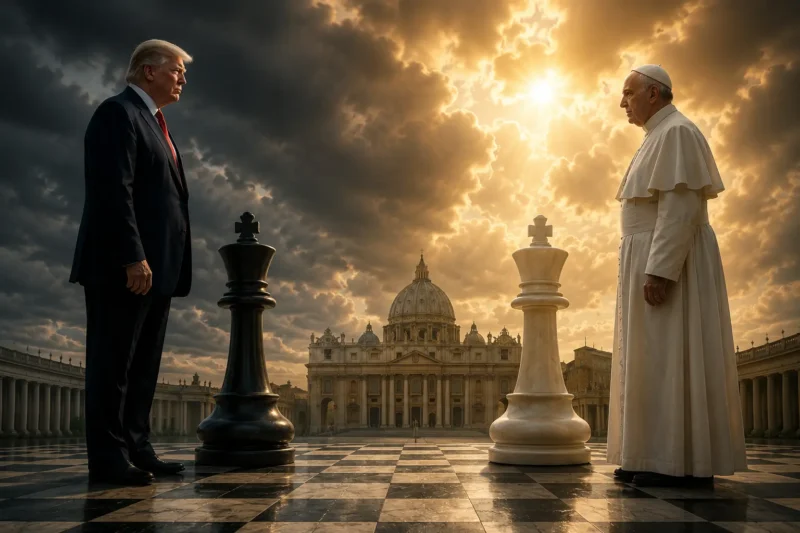
Trump vs Pope Leo XIV
Who Is Pope Leo XIV? The Man Behind the Clash
When Cardinal Robert Prevost stepped onto the balcony of St. Peter’s Basilica on May 8, 2025, nobody expected fireworks. A calm, scholarly Augustinian friar from Chicago, he took the name Pope Leo XIV and signaled a papacy of quiet healing — a direct contrast to the turbulent final years of Pope Francis.
He was the first American pope in the 2,000-year history of the US Catholic Church conflict. He spoke English. He understood American politics. And crucially — he was not afraid to use that understanding.
What Sparked the Trump vs. Pope Leo XIV Feud?
The flashpoint was the Trump Iran war in early 2026. As American missiles flew and casualties mounted, Pope Leo XIV called for peace. He warned world leaders of the “delusion of omnipotence” and declared that “God does not bless any conflict.”
For Donald Trump, who had publicly championed the military campaign, this was an intolerable rebuke. His response came via Truth Social — blunt, personal, and historically unprecedented.
Trump’s Exact Words on Truth Social
- Called Leo “WEAK on Crime, and terrible for Foreign Policy”
- Said: “I don’t want a Pope who criticizes the President of the United States”
- Claimed: “If I wasn’t in the White House, Leo wouldn’t be in the Vatican”
- Posted an AI image of himself as a Christ-like figure (later deleted)
- Accused Leo of believing Iran should have nuclear weapons — a claim with no factual basis
The Pope Punches Back — A New Kind of Papacy
Here is what made this feud unprecedented: Pope Leo XIV did not stay silent.
Rather than issuing a careful, diplomatic non-response, Leo named Trump directly — a rare move for any pope — and challenged him personally: “You started this war. You have the power to end this war.”
“The idea of the ‘quiet Pope Leo’ is a 2025 story. The 2026 Pope Leo is altogether different — more comfortable in his own skin, more comfortable saying the word Trump.”
Observers inside and outside the Vatican noted a clear evolution: the cautious new pope of 2025 had become a confident moral authority willing to stand toe-to-toe with the most powerful political figure on earth.
Read More:- India’s Defence Exports Cross ₹38,000 Crore — The Real Triumph of Make in India
How Did America React? The Numbers Tell a Clear Story
6 in 10 Americans had a negative reaction to Trump’s pope attacks
1.4B Catholics worldwide who follow Pope Leo XIV
~70M Catholics in the United States
6.6% Share of global Catholics from US + Canada
Even Trump’s own allies recoiled. Bishop Robert Barron called the remarks “entirely inappropriate and disrespectful” and demanded an apology. The response from the American Church was swift and unanimous: the President had gone too far.
Is This Truly Unprecedented in History?
Popes Have Always Engaged With Politics
It is not new for popes to weigh in on global conflicts. Pope John Paul II opposed the U.S. invasion of Iraq in 2003, sending personal representatives to both Washington and Baghdad. He correctly predicted decades of regional instability — and was ignored.
But Trump’s Attacks Cross a New Line
What is genuinely without historical parallel is a sitting U.S. president launching personal, name-calling attacks on the Pope of Rome via social media. The tone, the frequency, and the dishonesty — including repeatedly attributing a position on nuclear weapons that Leo never held — represent a new low in the relationship between Washington and the Holy See.
The Chilling Avignon Warning
Perhaps the most alarming detail to emerge: reports indicate that during a January 2026 meeting, a Pentagon official referenced the Avignon Papacy — the 14th-century period when the French Crown literally controlled the Catholic Church — as a “cautionary tale” for what could happen if the Vatican did not align with U.S. foreign policy.
Vatican officials interpreted the meeting as an attempt to secure moral backing for a potential military strike on Iran. The message, reportedly, was clear: cooperate, or history might repeat itself.
Who Is Winning This Battle?
The Scoreboard — Trump vs. Pope Leo XIV
- Public opinion: Pope Leo leads — nearly 60% of Americans sided with the Pope
- Moral authority: Analysts describe Leo as showing “strength and consistency” vs. Trump appearing “weak and erratic”
- Diplomatic damage control: Secretary of State Marco Rubio was dispatched to the Vatican on a fence-mending trip — suggesting the White House knew it had overstepped
- Global standing: The Pope leads 1.4 billion people across 200 nations; he answers to no government
- Institutional strain: U.S.–Holy See relations are under serious stress for the first time in decades
Why This Story Matters Beyond the Headlines
The Trump vs. Pope Leo XIV clash is not simply a celebrity feud or a social media spat. It raises profound questions that will shape global politics for years to come:
- Can state power silence moral authority? History suggests it rarely succeeds long-term.
- What is the role of religious institutions in an age of strongman politics?
- Does being American make the Pope more or less vulnerable to U.S. political pressure?
- Where is the line between a president’s right to criticize and an attack on an institution of 1.4 billion people?
The Bottom Line
Donald Trump has nuclear codes. Pope Leo XIV has 2,000 years of institutional authority and the moral allegiance of over a billion people. When these two forces collide, the historical record is fairly consistent: the White House rarely comes out ahead.
One man calls the other “WEAK on Crime.” The other responds by calling for peace in a time of war. The world is watching — and deciding for itself who the stronger voice really is.
In the contest between a president and a pope, right now, the Vatican is winning.
Read More:- Tamil Nadu Election Results 2026: Vijay’s Historic TVK Victory Is Reshaping State Politics
