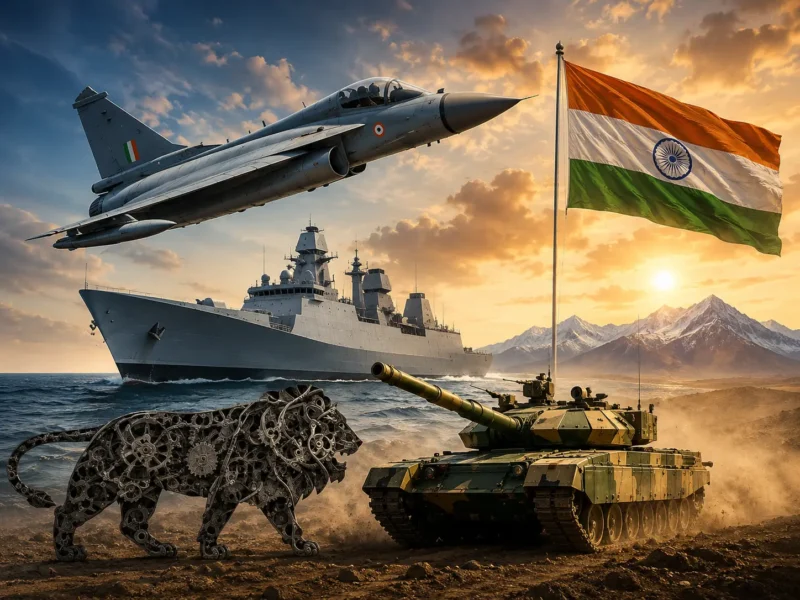
India’s Defence Exports
India has arrived on the global defence stage — and it’s not just talk anymore. In FY 2025–26, India’s defence exports touched a record ₹38,424 crore (approximately $4.6 billion), making it one of the fastest-growing defence exporters in the world. From BrahMos missiles to advanced drones, Indian-made weapons are now being ordered by countries across Asia, Africa, the Middle East, and beyond.
But how did a country that once imported nearly 70% of its defence equipment reach this milestone? The answer lies in a powerful combination of political will, industrial investment, and real-world validation on the battlefield.
The Make in India Revolution in Defence
When Prime Minister Narendra Modi launched the Make in India initiative in 2014, the defence sector was identified as one of its core pillars. For decades, India had been one of the world’s largest arms importers, heavily dependent on Russia, the US, France, and Israel for everything from fighter jets to rifles.
The government set a bold target: achieve ₹1.75 lakh crore in defence production and ₹35,000 crore in exports by 2025. Skeptics called it ambitious. But by 2026, India hasn’t just met the target — it has surpassed it.
Key policy reforms that drove this transformation include:
- Defence Production and Export Promotion Policy (DPEPP) 2020 — a dedicated roadmap for making India a global defence manufacturing hub
- Positive Indigenisation Lists — restricting imports of over 500 defence items, forcing domestic production
- FDI Liberalization — allowing up to 74% FDI in defence manufacturing under the automatic route
- Defence Industrial Corridors — two dedicated corridors in Uttar Pradesh and Tamil Nadu attracting billions in investment
Operation Sindoor: The Ultimate Game-Changer
If Make in India planted the seed, Operation Sindoor gave it the ultimate fertilizer — real combat validation.
In May 2025, India launched a series of precision strikes on terror infrastructure deep inside Pakistan following the deadly Pahalgam attack. The operation deployed an impressive arsenal of indigenously developed and assembled weapons — BrahMos missiles, loitering munitions, precision-guided bombs, and advanced drone systems.
The result? Every major system performed flawlessly under live combat conditions. Pakistan’s air defence systems were overwhelmed. Radar installations were destroyed. Terror camps were wiped out with surgical precision.
For international buyers, this was the most convincing sales pitch money can’t buy. You simply cannot fake battlefield performance.
“Battle-proven status of indigenous systems employed during the conflict resulted in India securing an unprecedented order worth ₹24,000 crore in new export contracts.” — Ministry of Defence, April 2026
In the global arms market, combat-proven systems command a premium. Israel’s weapon exports skyrocketed after the 1967 Six-Day War. The US F-16 became the world’s most popular fighter jet largely due to its combat record. India’s BrahMos, Akash missile system, and Tejas fighter are now following the same proven path.
Read More:- Tamil Nadu Election Results 2026: Vijay’s Historic TVK Victory Is Reshaping State Politics
What India Is Exporting — And To Whom
India’s defence export portfolio has grown remarkably diverse over the past few years.
Key Products in High Demand
- BrahMos Supersonic Cruise Missiles — the Philippines has already received deliveries; Indonesia, Vietnam, and several Middle Eastern nations are in active negotiations
- Akash Air Defence System — generating strong interest across Southeast Asia and the Gulf
- Advanced Towed Artillery Gun System (ATAGS) — exported to multiple friendly nations
- Dhruv Advanced Light Helicopter (ALH) — deployed by multiple countries
- Pinaka Multi-Barrel Rocket Launcher — in high demand post-Operation Sindoor
- Infantry Combat Vehicles and Armoured Personnel Carriers
- Naval Patrol Vessels and Fast Attack Craft
Key Export Destinations
Countries importing Indian defence equipment now include Armenia, Egypt, Mauritius, Sri Lanka, Indonesia, the Philippines, Vietnam, Saudi Arabia, the UAE, and several African nations — a list that is growing every quarter.
The Rise of Private Sector and Defence Startups
One of the most exciting developments in India’s defence ecosystem is the rise of private players and startups. Gone are the days when defence production was exclusively the domain of public sector giants like HAL, BEL, and DRDO.
Today, companies like Tata Advanced Systems, Mahindra Defence, L&T Defence, Alpha Design Technologies, and Ideaforge are winning both domestic and international contracts. Over 100 defence startups have emerged in the last five years, many developing cutting-edge drone technology, AI-powered surveillance systems, and electronic warfare solutions.
The government’s iDEX (Innovations for Defence Excellence) initiative has been a key catalyst, providing grants and procurement commitments directly to defence innovators — cutting red tape and accelerating delivery.
Challenges India Still Needs to Overcome
Despite the remarkable progress, India’s defence export journey isn’t without hurdles:
- After-sales service and global support networks are still being established
- Competing with legacy players like the US, Russia, France, and China on price and delivery timelines remains tough
- Technology transfer negotiations can be complex and slow to close
- Geopolitical sensitivities — India must carefully balance arms sales with its broader strategic partnerships
Addressing these challenges consistently will be critical to sustaining the export momentum long-term.
The Road Ahead: ₹50,000 Crore and Beyond
The Ministry of Defence has set an even more ambitious target: ₹50,000 crore in India’s Defence Exports by 2028. Given the current trajectory, this looks increasingly achievable.
India is in active negotiations for the Tejas Mk1A fighter jet with Malaysia and several other nations. The BrahMos-NG (Next Generation) — a lighter, faster, and more versatile variant — is expected to open up an entirely new export market. India’s growing Space Defence and Cyber Warfare capabilities are also being quietly marketed to select strategic partners.
The world is taking notice. India is no longer just a buyer at the global arms bazaar — it is rapidly becoming a seller, a supplier, and a strategic defence partner of choice for nations that value reliability, proven technology, and fair pricing.
Conclusion
The ₹38,424 crore defence export figure is far more than just a number on a spreadsheet. It represents a fundamental shift in India’s strategic confidence, industrial capability, and global standing. Make in India in defence is no longer an aspiration — it is a living, breathing reality, validated by the fire and smoke of Operation Sindoor.
As India refines its defence industrial base, expands its global marketing network, and continues to invest aggressively in R&D, the world can expect to see a lot more Made in India stamped on the weapons systems of tomorrow.
India forgets nothing. India forgives nothing. And now — India builds everything.
Read More:- Putin’s 2026 Russia-Ukraine Ceasefire: 5 Critical Facts Every Leader Must Know
