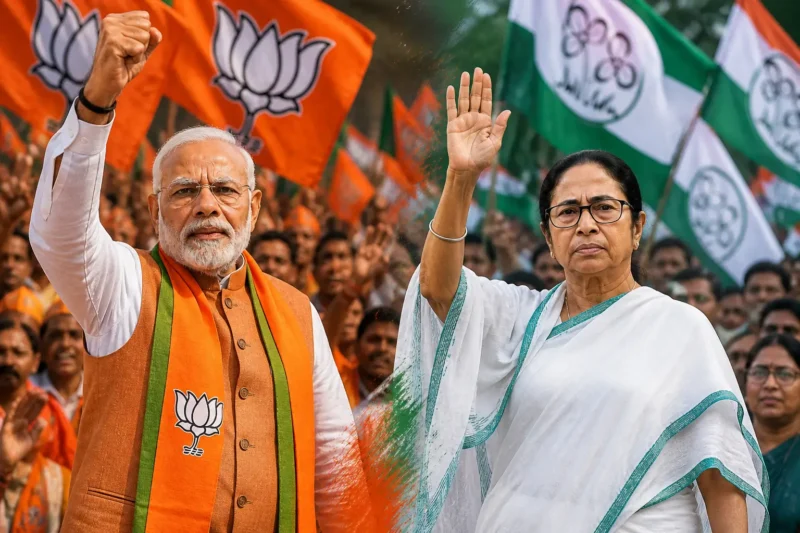
Introduction: The Battle for Bengal’s Future
The West Bengal 2026 election results are proving to be one of the most closely contested electoral battles in recent Indian political history. As results continue to pour in on May 4, 2026, the state is witnessing an intense fight between Mamata Banerjee’s All India Trinamool Congress (AITC) and the surging Bharatiya Janata Party (BJP).
With an impressive 92% voter turnout – the highest among all five states voting today – West Bengal’s electorate has sent a clear message: they want to participate in shaping their state’s political future. The question now is: who will emerge victorious?
West Bengal 2026 Election Results: The Current Status
Latest Trends and Vote Counts
As of the latest updates from May 4, 2026, the West Bengal election results show:
- Bharatiya Janata Party (BJP): Leading with 46 seats
- All India Trinamool Congress (AITC): Second position with 24 seats
This significant gap in the early trends suggests that the BJP is making unprecedented inroads into West Bengal’s political landscape, traditionally dominated by regional parties and the Left Front.
The Majority Mark
With 294 assembly seats in West Bengal, the majority mark stands at 148 seats. The contests are still ongoing, but current trends suggest this will be a closely fought election that could determine the state’s political direction for the next five years.
Read More:- West Bengal 2026 Election Results Countdown: The Epic Mamata vs BJP Battle
Understanding the Political Context
Mamata Banerjee’s Reign
Mamata Banerjee has been the Chief Minister of West Bengal since 2011, leading the Trinamool Congress party to power with the promise of change and regional autonomy. Over the past decade and a half, she has positioned herself as a regional icon and fierce critic of the BJP government at the center.
However, the 2026 election results are indicating that voter sentiment may be shifting. Several factors have contributed to this potential shift:
Key Factors in the 2026 Election:
- Economic Concerns – Rising inflation and unemployment have impacted voter sentiment
- Governance Issues – Complaints about administrative efficiency and corruption
- National Politics – Growing acceptance of BJP’s development agenda at the grassroots level
- Youth Demographics – Younger voters seeking change and new political options
The BJP’s Rising Influence
The BJP’s strong performance in the 2026 West Bengal election results marks a significant shift in the state’s political dynamics. The party, which has been continuously strengthening its organizational structure in West Bengal, is now translating ground-level mobilization into electoral gains.
Voter Turnout: A Story of Democratic Participation
One of the most remarkable aspects of the West Bengal 2026 election results is the 92% voter turnout – the highest among all voting states and union territories today.
What Does High Turnout Mean?
- Engaged Electorate: High voter participation indicates that West Bengal’s citizens are genuinely invested in the election outcome
- Competitive Race: When turnout is high, it often signals a closely contested election with multiple parties having reasonable chances
- Democratic Strength: This demonstrates the strength of India’s democratic institutions and the people’s faith in the electoral process
Constituency-Wise Analysis
Strong BJP Performance Areas
The West Bengal 2026 election results show that BJP is performing exceptionally well in:
North Bengal: Traditional strongholds of the Left Front are now seeing strong BJP consolidation. This shift is particularly notable in districts like Darjeeling, where the party has made significant gains.
Southern Suburbs of Kolkata: Urban constituencies in Kolkata’s peripheral areas show strong BJP performance, indicating penetration into middle-class and urban voter segments.
Eastern Districts: Districts like East Midnapore and West Midnapore show a swing towards the BJP, suggesting a broader anti-incumbency against the state government.
TMC’s Defensive Positions
The Trinamool Congress is holding on to its traditional bastions:
- South Kolkata: Still showing TMC strength in some constituencies
- Southern Districts: Areas with strong regional support for Mamata’s party
- Parts of Central Bengal: Some stronghold constituencies remain with TMC
The Broader Implications of West Bengal 2026 Election Results
National Politics Impact
The West Bengal 2026 election results have significant implications for India’s national political landscape:
- NDA Strength: A strong BJP performance would strengthen the NDA’s grip on Indian politics
- Regional vs. National: This election reflects the ongoing tension between regional parties and national political formations
- 2029 General Elections: These results could provide insights into voter preferences ahead of the next general elections
State-Level Governance
For West Bengal specifically, the election results suggest:
- Policy Shift: Potential change in state policies regarding industry, agriculture, and social welfare
- Administrative Changes: Personnel changes in key government positions
- Development Focus: Different prioritization of development projects and infrastructure spending
Market Reaction to West Bengal 2026 Election Results
The financial markets have responded positively to the election trends. The Sensex and Nifty showed bullish performance as early election results favored stability and political continuity.
Stock Market Impact
- Nifty 50: Climbed nearly 293 points as election results favored BJP in key states
- Sensex: Strong bullish movement with top gainers including Hindustan Unilever, Bajaj Auto, and Maruti Suzuki
- Investor Sentiment: Markets have traditionally responded well to political clarity and stable governance
Key Challenges Facing the Winner
Administrative Challenges
Regardless of who forms the government, the next administration will face:
- Economic Development: Creating jobs and attracting investments
- Infrastructure: Improving roads, power supply, and public transportation
- Healthcare & Education: Strengthening public institutions
- Law & Order: Maintaining communal harmony and security
Expectations from Voters
The West Bengal 2026 election results reflect voter expectations for:
- Good Governance: Efficient and transparent administration
- Economic Growth: Job creation and business-friendly policies
- Development: Better infrastructure and public services
- Security: Maintenance of law and order
What Happens Next?
Counting and Certification
As the counting of votes continues through May 4, 2026:
- Final Results: Official results will be declared once all votes are counted and verified
- Government Formation: The winning party/alliance will begin negotiations for government formation
- Oath-Taking: Chief Minister will take oath within the stipulated timeframe
First 100 Days
Historically, the first 100 days of any new government are critical, during which:
- Key policy initiatives are announced
- Cabinet formation and reshuffling occur
- Development projects are prioritized
Conclusion: West Bengal at a Political Crossroads
The West Bengal 2026 election results represent a pivotal moment in the state’s political history. With 92% voter turnout and a close contest between the BJP and TMC, the people of West Bengal have made their voice heard loud and clear.
Whether the BJP manages to form the government or the Trinamool Congress retains power, one thing is certain: the 2026 elections have demonstrated that West Bengal’s voters are engaged, active, and determined to shape their state’s future.
As counting concludes and final results emerge, the state awaits a government that can address its economic challenges, improve governance, and deliver on promises of development and progress.
The West Bengal 2026 election results are not just about seat counts and numbers – they represent the hopes, aspirations, and democratic choices of millions of citizens.
Read More:- Maharashtra Board Class 12 Result 2026: Complete Guide to Check Marks & Merit List
