
If you have been tracking the Indian stock market for even a few years, the name Reliance Power (NSE: RPOWER) needs no introduction. Once celebrated as one of India’s most anticipated IPOs — and then widely blamed as one of the biggest wealth destroyers for retail investors — Reliance Power has been through more ups and downs than most stocks you will find on the NSE.
But 2025 and 2026 feel different. Anil Ambani’s flagship power company has quietly cleared a mountain of debt, secured a landmark 25-year solar deal with SECI, won bids worth thousands of crores, and — perhaps most importantly — had the SEBI ban on its promoter lifted. The stock has also surged over 40% in April 2026 alone, catching many investors off-guard.
Quick Snapshot — Reliance Power (RPOWER) April 2026
CMP (NSE)
₹28.68
Live · Delayed 15 min
Market Cap
₹11,952 Cr
As of Apr 2026
52W High
₹76.49
Down ~62% from peak
52W Low
₹20.36
Apr 2026 rally started here
P/E Ratio
42x
Elevated for the sector
Asset Base
₹1.11L Cr
As of Sep 2025
What Is Reliance Power? — Company Overview
Reliance Power Limited, part of the Anil Dhirubhai Ambani Group (ADAG), was incorporated on January 17, 1995, under the name ‘Bawana Power Private Limited.’ It is today one of India’s largest private power generation companies by installed capacity, with a portfolio spanning thermal, hydro, solar, and wind energy.
Current Generation Portfolio
- Total Installed Capacity: 5,305 MW (as of 2025)
- Thermal Capacity: 5,160 MW — including the flagship 3,960 MW Sasan Ultra Mega Power Project (UMPP) in Madhya Pradesh
- Renewable Energy Capacity: 145 MW (operational), with a massive pipeline under development
- Rosa Power Plant: 1,200 MW installed capacity — marked another successful year in 2025
- Asset Base: ₹1,11,000 crore as of September 2025
What makes Reliance Power unique is not just its sheer scale, but the story of its transformation — from a debt-laden giant on the verge of collapse, to a company now actively competing for India’s largest renewable energy contracts.
Read More:- How to Make Money Using AI Tools in 2026: A Full Guide
The Rise, Fall & Comeback — A Story Every Investor Must Know
To truly understand where Reliance Power is headed, you need to understand where it came from. This is not just a stock story — it is one of the most dramatic corporate narratives in modern Indian business history.
- 2008 — The IPO That Broke RecordsReliance Power’s IPO raised ₹11,700 crore — the largest Indian IPO at the time. Subscribed 73 times. Anil Ambani was worth $42 billion. India was buzzing with optimism.
- 2008–2015 — The Long DeclinePost-IPO, the stock collapsed. Projects were delayed, debt piled up, coal supply agreements fell through. The stock that listed at ₹430 slowly bled.
- 2019–2020 — Near-Zero MomentBy 2020, Anil Ambani declared in a UK court that his personal net worth had reached zero. Reliance Power was drowning under ₹17,000+ crore of consolidated debt.
- 2024 — Debt Clearance BeginsThe company began aggressively paying off loans at discounted rates. Consolidated debt, which stood at ₹17,812 crore in June 2024, started shrinking rapidly.
- Early 2025 — SEBI Ban LiftedA critical turning point: the SEBI ban on Anil Ambani was lifted, allowing him to re-enter India’s securities markets. Legal clouds began to clear.
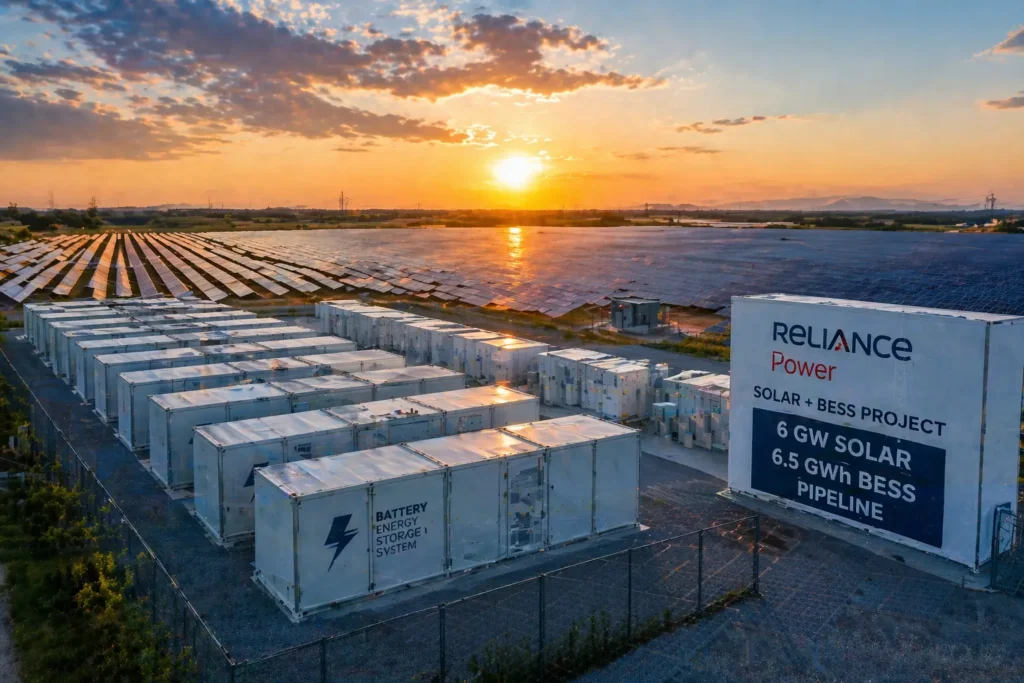
- May 2025 — SECI Mega Deal SignedSubsidiary Reliance NU Suntech signs a landmark 25-year PPA with SECI for 930 MW solar + 465 MW BESS — one of India’s largest-ever power offtake deals.
- Nov 2025 — SJVN Order WonReliance Power wins a bid for SJVN’s 750 MW Firm & Dispatchable Renewable Energy project, taking its solar pipeline to 6 GW solar + 6.5 GWh BESS.
- Apr 2026 — 40% Stock SurgeShares surge 40% in April 2026 alone, driven by debt-free status and investor optimism over the renewable energy pivot. Share price moves from ₹20.36 to ₹28.58.
Reliance Power’s Big Renewable Energy Bet — Asia’s Largest Solar Project
This is the part of the Reliance Power story that has genuinely excited long-term investors — and for good reason. The company is no longer just a thermal power player. It is making bold moves into India’s rapidly growing clean energy sector.
Landmark Deal
Reliance NU Suntech, a wholly owned subsidiary of Reliance Power, has signed a 25-year Power Purchase Agreement (PPA) with SECI — Solar Energy Corporation of India — for the supply of 930 MW of solar power integrated with a 465 MW / 1,860 MWh Battery Energy Storage System (BESS). Once commissioned, this will be Asia’s largest single-location solar + storage facility. Total investment: ₹10,000 crore (~$1.19 billion). Fixed tariff: ₹3.53 per kWh.
Why This Deal Matters for Investors
- Fixed Revenue for 25 Years: The 25-year tariff regime means Reliance Power will earn predictable, contracted cash flows for a generation — reducing business risk significantly.
- Asia’s Scale: The project deploys over 1,700 MWp of installed solar capacity. This is not a small pilot — it’s a statement of intent.
- BESS Integration: Battery storage makes the power supply dispatchable — meaning it can supply electricity on demand, not just when the sun shines. This commands premium tariffs and solves grid stability issues.
- Government Alignment: India’s target is 500 GW of renewable energy by 2030. Reliance Power is now squarely in the government’s priority lane.
Full Renewable Pipeline
| Project | Capacity | Type | Status |
|---|---|---|---|
| SECI Tranche XVII | 930 MW Solar + 465 MW BESS | Solar + Storage | PPA Signed |
| 350 MW Solar + BESS | 350 MW + 175 MW BESS | Solar + Storage | Under Development |
| SJVN FDRE Project | 750 MW | Firm & Dispatchable RE | Bid Won (Nov 2025) |
| PFC Financing Deal | N/A | ₹3,760 Cr Finance | Secured (2025) |
| Total Pipeline | 6 GW Solar + 6.5 GWh BESS | ||
Reliance Power Financials — The Numbers Investors Are Watching
One of the most common questions around Reliance Power is simple: are the fundamentals actually improving, or is this just a sentiment-driven rally? Let us look at the real numbers.
Key Concern
Net profit fell 96.97% year-on-year in Q2 FY2025-26, dropping to ₹87.32 crore. However, on a quarter-on-quarter basis, net profit jumped 95.43% compared to Q1 FY2026. The picture is mixed — improving sequentially, but still far from consistent profitability.
Cash Flow Snapshot (Annual)
| Activity | Mar 2025 | Mar 2024 | Mar 2023 |
|---|---|---|---|
| Operating Cash Flow | -₹20.54 Cr | ₹43.49 Cr | -₹9.94 Cr |
| Investing Activities | -₹2,510.80 Cr | -₹11.10 Cr | -₹1.70 Cr |
| Financing Activities | ₹2,520.89 Cr | -₹21.77 Cr | ₹10.62 Cr |
| Net Cash Flow | -₹10.45 Cr | ₹10.62 Cr | -₹1.02 Cr |
The large outflow in FY2025’s investing activities (₹2,510 crore) reflects the company’s aggressive capital deployment into new solar and BESS projects — a sign of growth investment rather than distress. The financing activities mirrored this, as the company raised fresh capital to fund these projects.
Other Key Financial Indicators
- Return on Equity (ROE): -9.68% over the past 3 years — still negative, a key concern for value investors
- Debtor Days: Improved from 93.2 days to 73.2 days — showing better collection efficiency
- Sales Growth (5 years): A tepid 0.05% — the company is not yet growing its top line meaningfully
- Interest Coverage Ratio: Low — indicating debt servicing remains a burden despite debt reduction
- P/B Ratio: 0.693 — trading below book value, which some value investors see as an opportunity
Reliance Power Share Price Target 2026, 2027, 2030
This is what most people searching for Reliance Power actually want to know — where is the stock headed? Here is a realistic breakdown based on current analyst data and market forecasts. Please note: these are estimates, not guaranteed returns. Always do your own research before investing.
2026 Target
₹36–45
Bear: ₹20
Bull: ₹45
2027 Target
₹55–65
Bear: ₹35
Bull: ₹80
2030 Target
₹100–150
Bear: ₹70
Bull: ₹190
Analyst Consensus
₹37.00
Current: ₹28.68
Upside: +29%
What Drives These Targets?
The bull case for Reliance Power’s price targets rests on three pillars: (1) successful and on-time commissioning of the SECI 930 MW and SJVN 750 MW renewable projects; (2) complete elimination of residual debt; (3) coal revenue gradually being replaced by high-margin, contracted renewable revenue. If all three happen, the stock has a credible case for significantly higher prices by 2030.
Risks Investors Cannot Ignore — The Other Side of the Story
Balanced investing means understanding both sides. Reliance Power’s recovery story is real — but so are the risks. Here is an honest look at what could go wrong.
ED Raids & Legal Cloud
In 2026, the Enforcement Directorate conducted raids at 10–12 locations linked to Reliance Power in Mumbai and Hyderabad, investigating financial irregularities. The Supreme Court has also been reviewing an SIT probe request involving allegations of ₹40,000 crore misappropriation under PMLA and FEMA by the Anil Ambani Group. While the company has denied these allegations, the legal overhang is real and could spook institutional investors.
- Strengths / Opportunities
- Debt-free status boosts balance sheet strength
- 25-year SECI deal provides stable cash flows
- SEBI ban on Anil Ambani lifted — cleaner governance
- India’s 500 GW renewable target creates huge tailwind
- 6 GW solar + 6.5 GWh BESS pipeline is industry-leading
- Stock trading below book value (P/B = 0.69)
- PFC ₹3,760 Cr financing secured — institutional backing
- Risks / Weaknesses
- ED raids & ₹40,000 Cr misappropriation allegations
- Net profit fell 96.97% YoY in Q2 FY26
- Negative ROE (-9.68%) over 3 years
- Low interest coverage ratio
- Sales growth virtually flat (0.05% in 5 years)
- Project execution risk — renewables are capital intensive
- Stock down 32.53% vs S&P BSE 100 over 6 months
Should You Invest in Reliance Power? — Honest Analysis
This is the question on every retail investor’s mind, and the honest answer is: it depends on your risk profile, investment horizon, and what price you are entering at.
Reliance Power is not a “safe” stock. It never has been. But the 2025–2026 version of the company is meaningfully different from the debt-ridden mess it was in 2020. The debt clearance is real. The SECI deal is real. The SJVN order is real. The fundamentals are slowly but genuinely turning.
However — and this is important — the legal risks are also real. ED raids, PMLA allegations, and SC scrutiny are not things to be taken lightly. If any of these result in serious action, the stock could fall sharply regardless of renewable energy progress.
Analyst View
Market analysts like Sugandha Sachdeva of SS WealthStreet advise investors to “wait for clearer signs of sustained recovery” before making major bets on Reliance Power. The consensus analyst target of ₹37.00 suggests around 29% upside from current levels — a reasonable return, but one that comes with above-average risk.
Who Should Consider RPOWER?
- High-risk, long-term investors: If you have a 5–10 year horizon and can stomach volatility, the renewable energy story has merit. Allocate a small, defined portion of your portfolio — not a concentrated bet.
- Traders: Watch key resistance levels. The stock has shown strong momentum in April 2026 (+40%) but technical indicators signal caution at current levels. Wait for consolidation.
- Conservative investors: This stock is NOT for you. Stick to PSU power companies or large-cap renewable players with consistent profitability and cleaner governance records.
FAQs — Reliance Power
Is Reliance Power debt-free now?↓
Yes — Reliance Power has largely cleared its debt as of 2025, after aggressively paying off loans at discounted rates from multiple bank creditors. This was a major turning point. However, investors should continue to monitor interest coverage ratios and quarterly filings for confirmation of debt-free status going forward.
Conclusion — The Reliance Power Verdict
The Reliance Power story of 2025–2026 is genuinely compelling — and genuinely complicated. On one hand, you have a company that has cleared its debt, secured Asia’s largest solar + storage project deal, won major government orders, and seen its promoter’s regulatory cloud lifted. On the other hand, you have ED raids, weak quarterly profits, negative ROE, and a stock that remains massively below its 52-week high.
The truth is that Reliance Power is at an inflection point — but whether that inflection goes up or sideways depends almost entirely on two things: project execution (can the SECI and SJVN projects be commissioned on time?) and legal resolution (do the ED and SC cases result in serious action?).
