Why Are Petrol & Diesel Price Not Changing in India?
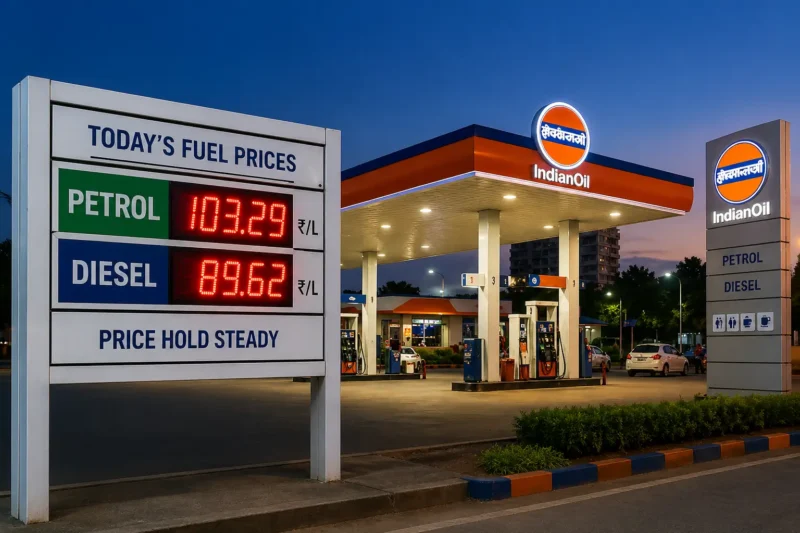
Petrol & Diesel Prices: On April 27, 2026, fuel prices across most major Indian cities remain unchanged. According to government data, there has been no significant hike or cut in petrol or diesel rates today. For millions of Indians, this comes as welcome relief — especially amid rising inflation and a brutal summer heatwave.
But stability doesn’t happen by accident. Let’s understand the key factors at play.
How Are Petrol and Diesel Prices Decided in India?
Before we dive into the reasons for stability, it helps to understand the pricing mechanism for fuel in India.
India follows a dynamic fuel pricing system, introduced in 2017. Under this system, state-owned oil marketing companies (OMCs) — namely Indian Oil Corporation (IOC), Bharat Petroleum (BPCL), and Hindustan Petroleum (HPCL) — are allowed to revise prices daily based on:
- International crude oil prices (India imports nearly 85% of its crude oil)
- Foreign exchange rates (USD/INR fluctuation)
- Central government taxes — Excise Duty
- State government taxes — VAT (Value Added Tax)
- Dealer commissions
- Transport and refinery costs
This means that theoretically, fuel prices should change every day. But in practice, they often don’t — and here’s why.
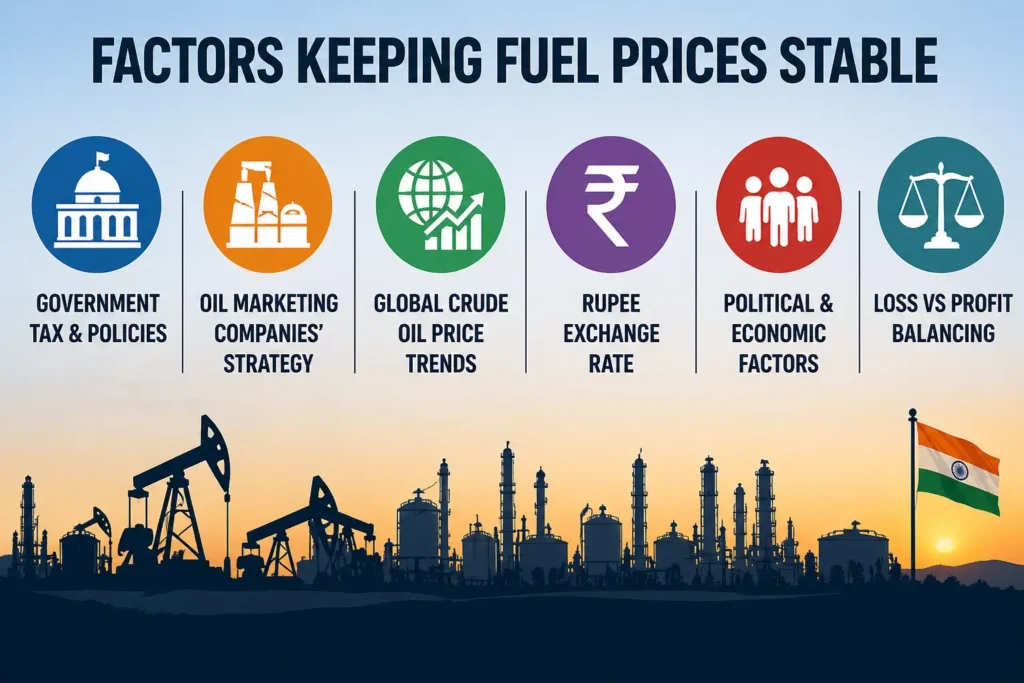
5 Key Reasons Petrol & Diesel Prices Are Stable Right Now
1. Global Crude Oil Prices Are in a Sweet Spot
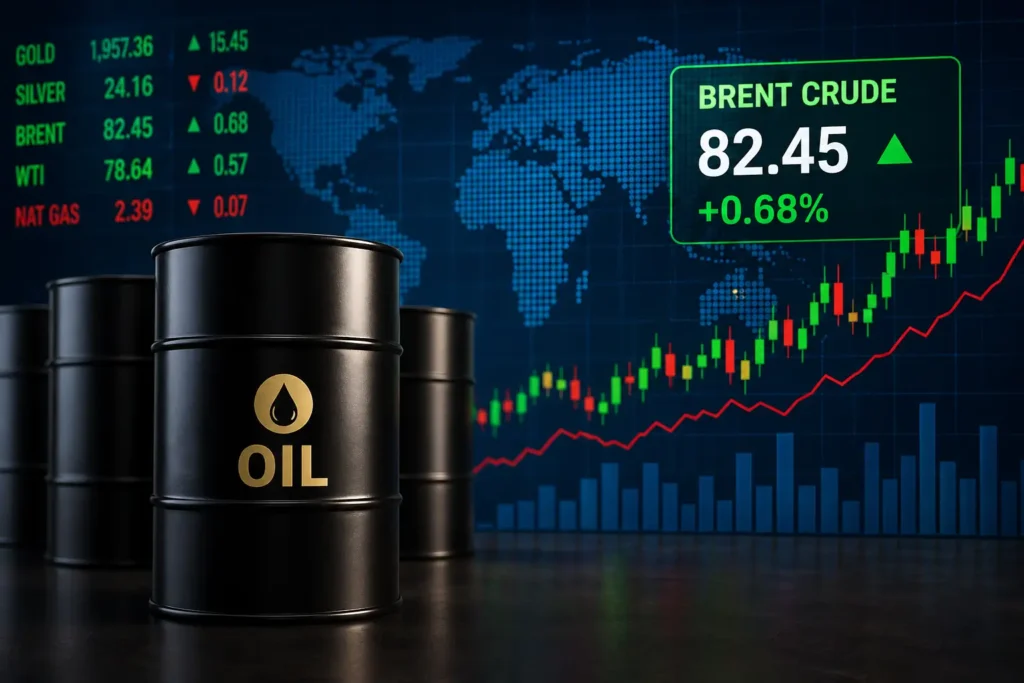
One of the biggest reasons for stable domestic fuel prices is the relative stability in international crude oil prices. While there has been volatility in global oil markets due to geopolitical tensions and OPEC+ supply decisions, prices have been hovering in a range that does not demand an immediate revision at the pump.
When Indian Oil Prices are neither sharply rising nor falling, OMCs have less pressure to pass on changes to consumers. This “wait and watch” approach is common, especially when swings are short-term.
2. Government Policy & Election Sensitivity
India’s political calendar plays a massive role in fuel pricing decisions. With several state assembly elections scheduled in 2026, the central and state governments are extremely cautious about triggering public anger through fuel price hikes.
Historically, Indian governments have avoided raising petrol and diesel prices close to elections. This political buffer is one of the most underrated factors keeping fuel rates unchanged in the short term.
3. Stable USD-INR Exchange Rate
India pays for crude oil in US dollars. So when the Indian Rupee weakens against the dollar, the cost of importing oil automatically rises — even if international crude prices stay the same.
Currently, the USD/INR rate has been relatively stable, which means the landed cost of crude oil for Indian refiners hasn’t changed dramatically. This removes one key trigger for a price revision.
4. Buffer Margins of Oil Marketing Companies (OMCs)
Indian OMCs don’t always immediately pass on price changes to consumers. They maintain marketing margins — a financial cushion that absorbs short-term fluctuations. When crude prices dip, OMCs often rebuild their margins before reducing retail prices. Similarly, when crude rises slightly, they absorb the hit temporarily.
Right now, OMCs appear to be operating within a comfortable margin range, reducing the urgency for any revision.
5. Strategic Petroleum Reserves & Import Diversification
India has been diversifying its oil import sources over the past few years, buying discounted crude from Russia, the Middle East, and other suppliers. This has helped reduce the average cost of crude oil procurement, giving the government more flexibility in managing retail prices.
Additionally, India’s Strategic Petroleum Reserves (SPR) act as a buffer against sudden supply shocks — another factor contributing to price stability.
Read More:- Raghu Rai Is No More, But His 50,000+ Photographs Are India’s Eternal Legacy
City-by-City Petrol & diesel price today India Snapshot
Here’s a quick look at today’s fuel prices in major Indian cities:
| City | Petrol (₹/litre) | Diesel (₹/litre) |
|---|---|---|
| Delhi | ~94.77 | ~87.67 |
| Mumbai | ~103.44 | ~89.97 |
| Chennai | ~100.85 | ~92.44 |
| Kolkata | ~104.95 | ~91.76 |
| Bengaluru | ~102.86 | ~88.94 |
| Bhopal | ~107.23 | ~90.87 |
| Jaipur | ~104.88 | ~90.36 |
Note: Prices vary by city due to different state VAT rates and local levies. Always check your city’s rate via the SMS service (send RSP to 9224992249) or the IOC/BPCL/HPCL mobile apps.
Why Do Fuel Prices Differ Across Indian Cities?
Many people wonder — if there’s a single government policy, why is petrol ₹94 in Delhi but over ₹107 in Bhopal?
The answer lies in state-level taxes. Every state in India charges its own Value Added Tax (VAT) on fuel, which can range from as low as 15% to over 35%. States with higher VAT — like Maharashtra, Madhya Pradesh, and Telangana — naturally have higher pump prices.
Other city-specific factors include:
- Distance from refineries (longer transport = higher freight cost)
- Local body levies in select cities
- Urban vs. rural distribution costs
What Does Fuel Price Stability Mean for You?
Stable fuel prices have a ripple effect across the entire economy. Here’s how it benefits ordinary Indians:
Lower Inflation Pressure
Fuel is a key input cost for transportation, agriculture, and manufacturing. When diesel prices are stable, freight costs don’t rise, which keeps the prices of vegetables, grains, and goods in check.
Budget Relief for Middle-Class Households
For a family that spends ₹5,000–₹8,000 per month on fuel, price stability means predictable expenses. No sudden shocks to monthly budgets.
Positive Sentiment for Businesses
Small businesses — especially logistics companies, taxi operators, and delivery services — heavily depend on diesel. Stable fuel prices mean stable operating costs, which supports profitability and job security.
Support for Farmers
Diesel powers tractors, water pumps, and agricultural machinery. Steady diesel prices during the Rabi and Kharif harvest seasons directly reduce input costs for farmers.
How Long Will This Stability Last?
The big question on everyone’s mind — is this fuel price stability here to stay?
Honestly, it depends on several unpredictable variables:
- OPEC+ production decisions: Any sudden cut in oil supply can spike crude prices.
- Geopolitical developments: Conflicts in the Middle East or Russia-Ukraine situation can disrupt supply chains.
- Monsoon & seasonal demand: Fuel demand typically increases post-monsoon in India.
- Election cycle: Post-election periods often see fuel price corrections.
- Global recession fears: A slowdown could actually lower crude prices, giving India room to cut fuel rates.
Most economists and energy analysts suggest that Q2 2026 (April–June) will likely see fuel prices remain range-bound, barring any major shock. However, a revision — upward or downward — cannot be ruled out in the second half of the year.
Tips to Save Money on Fuel Right Now
Even with stable prices, smart fuel management can save you significant money:
- Fill up in the morning — fuel is denser in cooler temperatures, so you get slightly more per litre.
- Use fuel cashback credit cards — several banks offer 5%–10% cashback on fuel transactions.
- Maintain your vehicle regularly — a well-tuned engine delivers better mileage.
- Avoid aggressive acceleration — smooth driving can improve fuel efficiency by up to 20%.
- Check tyre pressure weekly — under-inflated tyres increase fuel consumption.
- Use apps to compare nearby fuel stations — prices at private pumps (like Shell or BP) may occasionally differ.
The Bigger Picture: India’s Long-Term Fuel Future
While we all appreciate today’s stable prices, the long-term answer to fuel price volatility lies in reducing India’s dependence on crude oil altogether.
India is aggressively pushing its EV (Electric Vehicle) adoption, with the government targeting 30% EV penetration by 2030. Simultaneously, ethanol blending in petrol has crossed 15% nationally — reducing the volume of pure petrol consumed.
These structural shifts won’t eliminate petrol and diesel overnight, but they’re slowly but surely reducing India’s vulnerability to global oil price shocks. For now though, the steady pump prices are a welcome breather for every Indian — from the auto-rickshaw driver in Bhopal to the long-haul trucker in Punjab.
Final Thoughts
Stable pdiesel and petrol price today are the result of a complex interplay of global crude trends, government policy, rupee strength, and OMC strategy — not just luck. While this stability is good news for consumers and businesses alike, it’s important to stay informed, because the fuel price situation can shift quickly.
Read More:- Stock Market Investment 2026: Right or Wrong? Complete Beginner’s Guide
