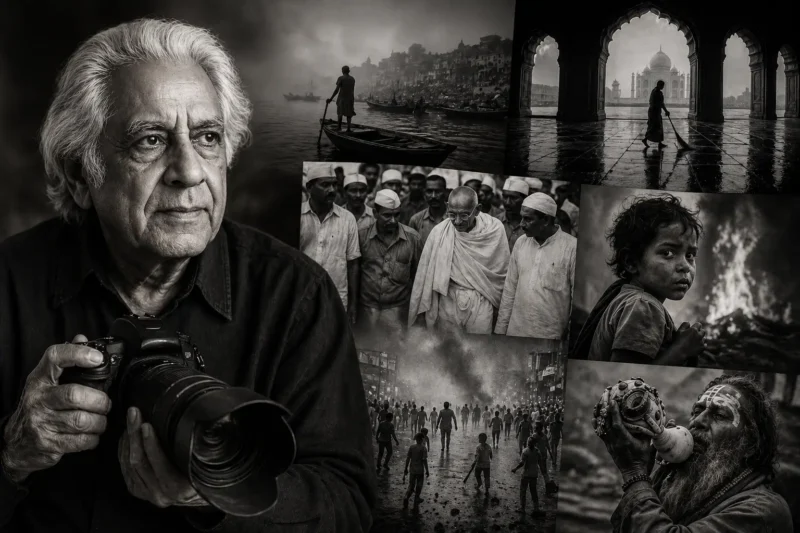
India lost one of its most treasured voices today — not a voice that spoke words, but one that spoke through light, shadow, and the raw truth of a single frame. Raghu Rai, India’s greatest photographer, passed away on April 26, 2026, at the age of 83. But while the man is gone, the 50,000+ photographs he left behind will continue to tell India’s story for generations to come.
Introduction: Who Was Raghu Rai? A Brief
If you have ever seen a photograph that made you stop breathing for a moment — one that captured grief, joy, chaos, or silence in a single frame — there is a good chance it was taken by Raghu Rai.
Born on December 18, 1942, in the small village of Jhang in pre-partition Punjab (now Pakistan), Raghu Rai did not grow up dreaming of becoming a photographer. He trained as a civil engineer. Yet destiny had other plans. In the early 1960s, inspired by his elder brother S. Paul — himself a well-known photojournalist — Raghu picked up a camera and never put it down.
What followed was one of the most remarkable careers in the history of photography — not just in India, but across the world.
From the Streets of Delhi to the Halls of Magnum Photos
Raghu Rai’s rise was neither accidental nor overnight. He joined The Statesman newspaper in New Delhi as a staff photographer in the mid-1960s, where he quickly distinguished himself with his sharp instinct and deeply human eye. By 1976, he had left the paper to work as a freelance photographer, and by 1977, something historic happened.
Henri Cartier-Bresson — the French photography legend widely regarded as the father of modern photojournalism — nominated Raghu Rai to join Magnum Photos.
This was a defining moment. Magnum Photos, founded in 1947 in New York, is the most prestigious photography cooperative in the world. Raghu Rai became not only the first Indian member of Magnum Photos but one of the very few Asians to ever receive this honour. His entry into Magnum was a global stamp of approval on what Indian photography could achieve.
For years after, Raghu Rai served as the Director of Photography for India Today magazine (1982–1992), contributing unforgettable photo essays on social, political, and cultural themes that shaped how a generation of Indians saw their own country.
The Photographs That Defined a Nation
What makes Raghu Rai’s body of work truly extraordinary is its range and depth. He did not specialize in one corner of Indian life — he photographed all of it, with equal sensitivity and equal power.
1. The Bangladesh Liberation War (1971)
When Bangladesh fought for its independence in 1971, Raghu Rai was there. His photographs of the refugee crisis — thousands of displaced, desperate, exhausted human beings — remain among the most powerful war photographs ever taken by an Indian photographer. These images were not just journalism; they were a moral call to the world.
2. Indira Gandhi — A Portrait of Power
Raghu Rai had unparalleled access to India’s most powerful political figures, none more iconic than Indira Gandhi. His portraits of the former Prime Minister captured her in moments of authority, vulnerability, and quiet resolve. These photographs remain the definitive visual record of one of the most consequential leaders in Indian history.
3. The Bhopal Gas Tragedy (1984)
Perhaps the most haunting chapter in Raghu Rai’s career was his documentation of the Bhopal gas disaster — India’s worst industrial catastrophe, in which a gas leak from a Union Carbide plant killed an estimated 25,000 people. Raghu Rai’s photographs of the victims — their faces, their pain, their abandoned lives — went around the world and became a rallying cry for justice. His work on Bhopal resulted in an entire book: Exposure: A Corporate Crime, and three international exhibitions that toured Europe, America, India, and Southeast Asia.
4. Mother Teresa — A Sacred Bond
Of all the subjects Raghu Rai photographed over his lifetime, none held a more special place than Mother Teresa. His intimate, deeply personal photographs of the Nobel Peace Prize laureate capture not just the woman, but the spirit behind her mission. These images are tender, spiritual, and timeless.
5. The Soul of Old Delhi
Long before Instagram filters made Old Delhi look exotic, Raghu Rai was walking its gullies with his camera, finding beauty, dignity, and humanity in every corner. His photographs of ordinary Delhi life — a man reading a newspaper on a train, a vendor on a crowded street — carry an emotional weight that no algorithm can replicate.
Also read:- Stock Market Investment 2026: Right or Wrong? Complete Beginner’s Guide
The Philosophy Behind the Lens
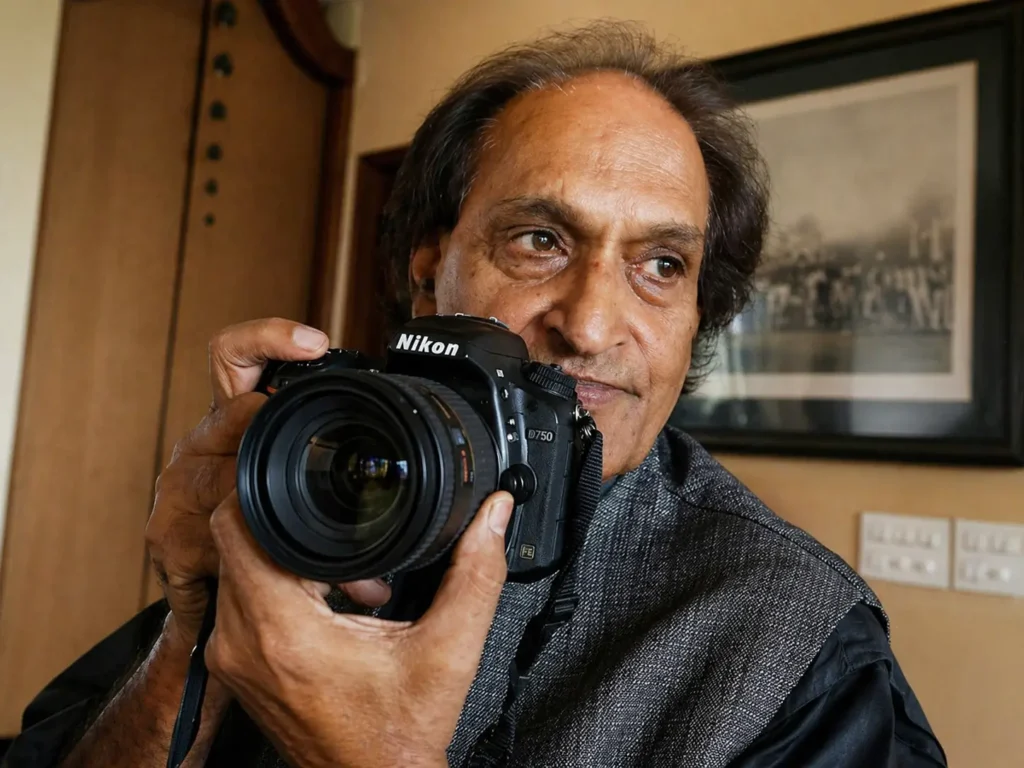
What separated Raghu Rai from his contemporaries was not just technical brilliance — it was his philosophy of photography.
“An instinctive response is free from the mind, from ideas, from all those trappings of the mind. Your instinct lives beyond your head. If you are photographing the world by your instinct, then no influence stands in your way.” — Raghu Rai
This belief in pure instinct — in seeing before thinking — is what gave his photographs their raw, unfiltered truth. He did not “compose” his shots the way a studio photographer might. He felt them. And the camera simply followed.
This approach to photography is as relevant today as it was 60 years ago. In an era of over-edited, over-filtered, AI-generated imagery, Raghu Rai’s philosophy is a reminder that the most powerful photograph is the one taken from the gut, not the grid.
Awards, Honours, and a Legacy Written in Silver Gelatin
Over his six-decade career, Raghu Rai accumulated an extraordinary list of awards and recognitions:
- Padma Shri (1972) — One of India’s highest civilian honours, and one of the first ever awarded to a photographer
- Officier des Arts et des Lettres (2009) — Conferred by the French government for his extraordinary contribution to art and photography
- Academie des Beaux-Arts Photography Award — William Klein (2019) — One of Europe’s most prestigious photography honours
- Photographer of the Year (USA) — Awarded for his National Geographic cover story, Human Management of Wildlife in India (1992)
- World Press Photo Jury Member — He served on the jury from 1990 to 1997, influencing global photojournalism standards
He also authored more than 56 books, including Raghu Rai’s Delhi, The Sikhs, Calcutta, Taj Mahal, Tibet in Exile, and Mother Teresa. At the time of his passing, he was working on his 57th book — a testament to a man who never stopped creating.
The Raghu Rai Foundation — 50,000 Images, One Living Archive
In 2010, the Raghu Rai Foundation was established to preserve and promote his extraordinary body of work. The Foundation houses over 50,000 of his images — a staggering archive that represents not just one photographer’s career, but six decades of Indian history.
This archive is India’s visual memory. It includes images of political upheaval, natural disasters, spiritual celebrations, everyday moments of joy and sorrow, and portraits of some of the most significant human beings of the 20th century.
As India moves deeper into the digital age, this archive becomes more important — not less. Because in a world of deepfakes and AI-generated imagery, Raghu Rai’s photographs stand as an undeniable record of what actually happened, and how it actually felt.
What Raghu Rai Death Means for Indian Photography
The passing of Raghu Rai leaves a void that cannot be filled. He was not merely a photographer — he was India’s visual conscience. He held a mirror to the nation and asked it to look carefully, honestly, and without flinching.
Shashi Tharoor, Member of Parliament, perhaps said it best in his tribute: “He was an incomparable master of photography, the visionary who captured the pulsating heart and soul of India.”
Rahul Gandhi, Leader of the Opposition, added: “He didn’t just take photographs, he preserved our nation’s memory.”
These tributes speak to something rare — the fact that Raghu Rai’s work transcended politics, religion, language, and region. His photographs belonged to all of India, and in many ways, to all of humanity.
Lessons Every Aspiring Photographer Can Learn from Raghu Rai
Even in grief, there is wisdom to be gathered. For every young photographer in India today, Raghu Rai’s life offers a masterclass:
- Trust your instinct — The best photograph is often the one you take before you think
- Stay curious — Raghu Rai photographed India for 60 years and never stopped discovering it
- Be present — His greatest images came from being fully in the moment, not behind a screen
- Serve the story — He always put his subject above himself; the story was never about him
- Keep working — He was writing his 57th book at 83. Enough said.
Final Words — A Photograph Never Dies
There is a beautiful paradox in the death of a photographer. The person leaves, but every photograph they ever took remains. Every image is a small act of immortality — a frozen moment that will outlast everyone in it, including the person who pressed the shutter.
Raghu Rai took over 50,000 such moments. He gave India 50,000 pieces of itself to look at, to learn from, and to remember.
He is gone. But open any one of his books, look at any one of his photographs, and you will feel his presence immediately — in the stillness of a portrait, in the chaos of a street, in the grief of a disaster survivor’s eyes.
Raghu Rai is no more. But his photographs? They are eternal.
Also read:- LSG vs RR Match Prediction 2026: Odds, Form, and Weather Report — Who Will Win Tonight?
